How to Build a Startup MVP Without Hiring 5 Different Vendors
A practical MVP guide for founders who need product clarity, design, development, and launch thinking in one focused roadmap.
Written and reviewed by the RubrixCode Editorial Team.
Learning how to build a startup MVP is not really about building less. It is about choosing the smallest version of the product that can still prove something important. A landing page with no product is often too thin. A full platform with every possible feature is usually too expensive. The real MVP sits between those extremes: clear enough to sell, useful enough to test, and focused enough to ship.
Most early founders lose time because they treat the MVP like a list of features. They hire a designer for screens, a developer for code, a marketer for launch copy, and someone else for social content. Each person may do good work, but the product starts to feel stitched together. The message says one thing, the interface says another, and the roadmap becomes hard to control.
A better MVP process starts with one question: what must a customer believe, do, or pay for before we know this idea deserves more investment?
Begin with the decision the MVP must prove
Before writing user stories, define the decision the MVP should unlock. Are you trying to prove that customers understand the offer? That they will book a consultation? That they will pay for a subscription? That a workflow saves measurable time? The answer changes what you build.
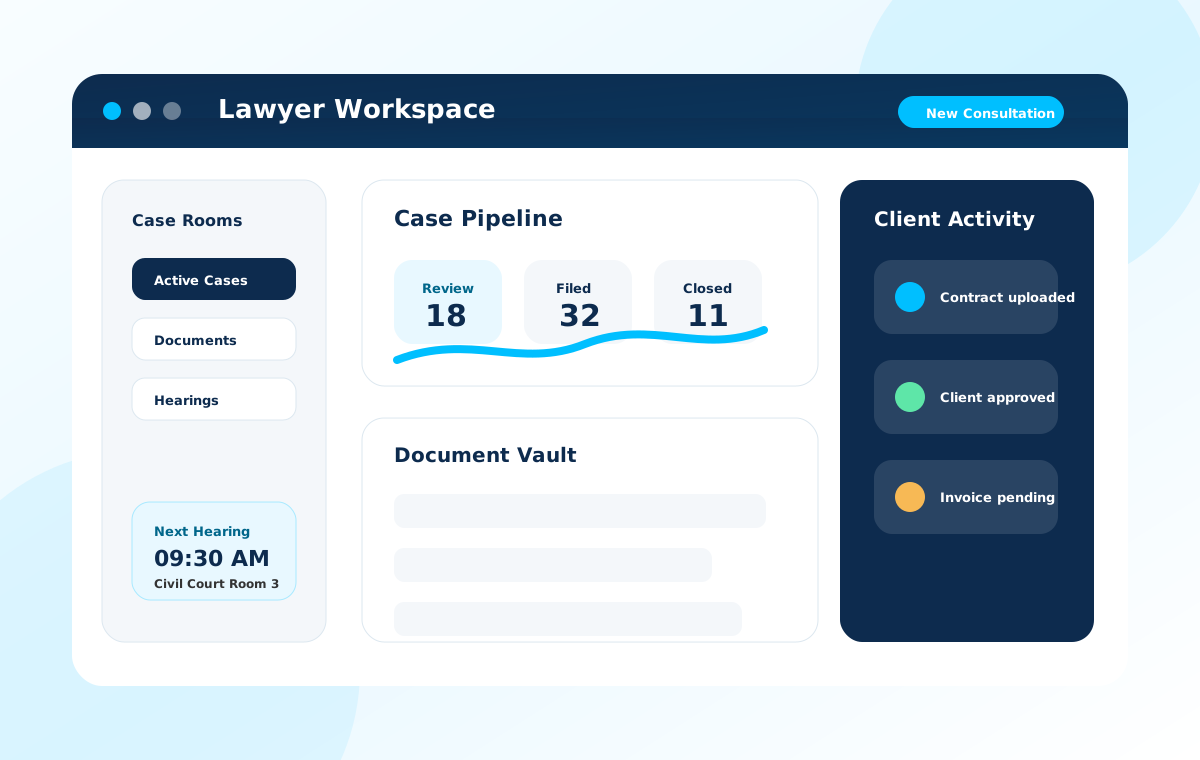
For example, a legal-tech startup may not need a complete case management platform on day one. It may need a clear lawyer dashboard, client intake flow, document upload path, and consultation booking experience. That is enough to test whether lawyers and clients trust the concept. Extra modules can wait.
This step is uncomfortable because it forces discipline. Founders naturally want to protect the big vision. But an MVP is not a smaller dream. It is a sharper experiment.
- Define the audience and the painful moment they want solved.
- Write the one business assumption the MVP must test.
- Choose the minimum workflow that proves or disproves that assumption.
- Remove any feature that does not help the test.
If the MVP does not answer a business question, it is just an expensive prototype.
Map the journey before the screens
A strong MVP is built around a journey, not isolated pages. The journey usually has five parts: the user arrives, understands the promise, takes the first action, completes the core task, and sees a reason to return. Each part needs a clear message and a clear interface.
This is where UI/UX design becomes a business tool. Wireframes are not just visual planning. They reveal friction before development starts. If a founder cannot explain why a user moves from one screen to the next, code will not fix the confusion.
A useful exercise is to write each screen as a sentence. The homepage says, 'Here is why this product matters.' The signup screen says, 'Create your account with minimal effort.' The dashboard says, 'Here is the next most useful action.' If the sentence is unclear, the screen will probably be unclear too.
- Build the path from first visit to first value.
- Reduce decisions on each screen.
- Use plain labels and benefit-led copy.
- Design empty states, errors, and loading states early.
Choose a stack that can move quickly
The right stack for a startup MVP is not always the trendiest stack. It is the stack that lets the team ship quickly, maintain the product, and avoid a rewrite if validation works. For many web MVPs, a modern React or Next.js frontend with a structured backend is enough. For mobile, Flutter and React Native can reduce duplicate work across iOS and Android. For blockchain, smart contract risk means clarity and testing matter more than visual flash.
Technical choices should also reflect the founder's next six months. If the MVP needs admin dashboards, analytics, authentication, payments, or content updates, those should be planned from the beginning. Retrofitting them later can be more expensive than including a simple version at launch.
A good product partner should explain tradeoffs in normal language. Founders do not need a lecture on every library. They need to know what is fast, what is scalable, what is risky, and what can wait.
Treat launch content as part of the product
A product that works but cannot be explained will struggle to get feedback. That is why the landing page, onboarding copy, email follow-up, and social launch content should be treated as part of the MVP. They are not decorations. They are the bridge between the product and the first customer.
This is where an end to end digital agency model helps. When the same team understands the interface, the code, and the launch message, the MVP feels more coherent. The CTA matches the product. The screenshots match the promise. The social content sends people to the right action.
For a startup with limited budget, coherence is a competitive advantage. It makes the company look more mature than its size.
An MVP should be built to learn, but it still has to look trustworthy enough for people to try it.
Common Questions
How long does it take to build a startup MVP?
A focused MVP can often be planned in one to two weeks and built in four to eight weeks, depending on complexity. The timeline becomes longer when the product needs payments, mobile apps, blockchain features, or heavy integrations.
What should be included in an MVP?
An MVP should include the smallest complete workflow that proves the core business assumption. It usually needs a clear landing page, onboarding path, core user action, basic admin control, analytics, and a simple support or feedback loop.